Webflow builds for ambitious B2B teams
Webflow is one of three stacks we ship — the right call when your marketing team needs to edit weekly without waiting on a developer. Need AI-native or a custom AI product instead? See AI Products.
The website that shipped your last raise won't ship your next one
Three patterns we see in nearly every B2B site we audit.
Every change is a developer ticket
Marketing wants to ship a campaign page on Tuesday. Engineering reviews the ticket Friday. By the time it goes live, the moment has passed.
The CMS and the design are at war
Templates that fight your brand. Editors hand-coding HTML in rich text fields. Components that look nothing like the Figma file shipped them.
Your stack is a museum of past decisions
WordPress plugins from 2019. A page builder bolted on in 2021. Custom PHP nobody wants to touch. Each new feature ships slower than the last.
Webflow in 2026 isn't the Webflow you remember
The platform has quietly outgrown its "no-code site builder" label.
Visual development, real code output
Webflow ships clean, semantic HTML and CSS — no shortcode soup, no theme bloat. AI engines parse it, screen readers respect it, browsers render it fast.
A CMS your marketing team actually uses
Structured collections, reference fields, multi-reference filtering. Editors publish without breaking the layout, because the layout was built around the data shape.
Performance that beats most React stacks
Server-rendered, edge-cached, image optimisation built in. Lighthouse scores in the 90s without a performance engineer on retainer.
Animation and interaction without JS gymnastics
Scroll-linked timelines, micro-interactions, page transitions — designed visually, exported as performant code. The kind of polish that used to require a custom build.
Webflow + AEO
Why Webflow has quietly become an AEO advantage
AI search engines reward sites that are fast, semantic and machine-readable. Webflow is all three by default — which is why our Webflow clients tend to show up in ChatGPT and Perplexity citations months before their WordPress competitors do.
What AI engines actually need from your site
- Server-rendered HTML so crawlers see content without executing JavaScript.
- Semantic tags — real
<h1>,<article>,<table>markup that conveys meaning, not div soup. - Structured data — Schema.org JSON-LD on every meaningful page (Article, FAQPage, Service, Organization).
- An
llms.txtfile at the root, declaring which pages matter and why. - Fast Core Web Vitals — slow pages get crawled less often and cited less prominently.
Where Webflow gives you a head start
Webflow ships server-rendered, semantic HTML out of the box. Headings nest properly. Images get alt text fields. Pages publish at the edge with sub-second TTFB. You can inject custom JSON-LD per page from the CMS without writing a line of code.
None of this is possible in WordPress without four plugins, a caching layer and a developer who agrees to maintain them.
Where we add the AEO layer on top
We treat AEO as a discipline, not a checkbox. Every Webflow build we ship includes a structured-data audit, an llms.txt generated from the sitemap, schema.org JSON-LD wired into CMS templates, and a citation-tracking dashboard so you can see which AI engines are referencing you over time.
Your team builds the site together, in real time
Webflow's Designer is multiplayer. Designers, developers and marketers work on the same canvas at the same time — like Figma, but for your live site.
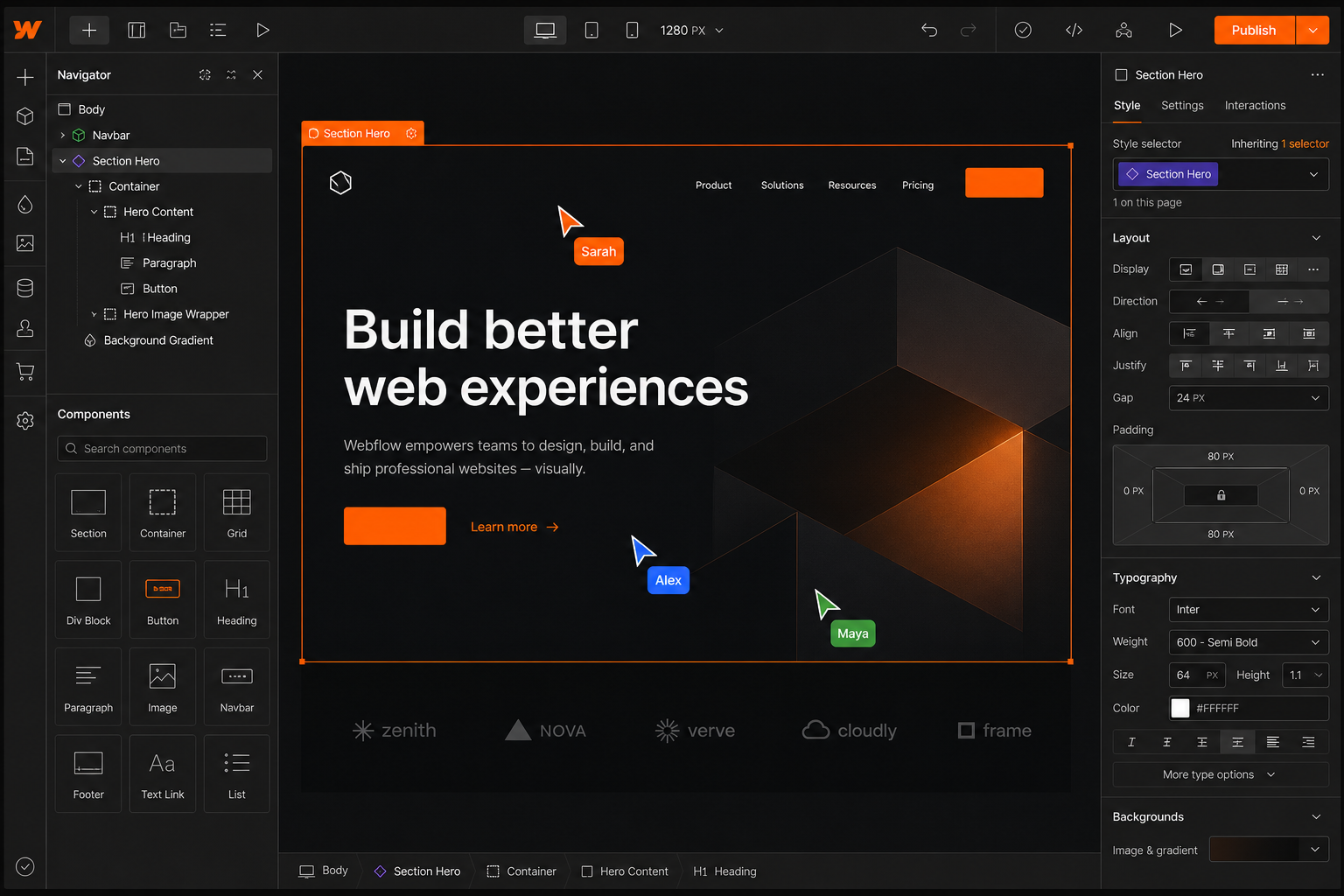
| Criteria | WordPress / Static builders | Webflow |
|---|---|---|
| Concurrent editors | One at a time — second editor gets a lock screen | Multiple cursors live on the same canvas |
| Design review | Screenshots in Slack, comments in a separate doc | Comment directly on elements in the Designer |
| Staging → production | Manual sync, plugin conflicts, cache busting | One-click publish from staging branch |
| Rollback | Restore a backup, hope the database matches | Time-travel to any prior version, instant revert |
Concurrent editors
- WordPress / Static builders
- One at a time — second editor gets a lock screen
- Webflow
- Multiple cursors live on the same canvas
Design review
- WordPress / Static builders
- Screenshots in Slack, comments in a separate doc
- Webflow
- Comment directly on elements in the Designer
Staging → production
- WordPress / Static builders
- Manual sync, plugin conflicts, cache busting
- Webflow
- One-click publish from staging branch
Rollback
- WordPress / Static builders
- Restore a backup, hope the database matches
- Webflow
- Time-travel to any prior version, instant revert
Day-to-day team workflow on a B2B brand site.
The template trap — and why we don't fall into it
Most "Webflow agencies" are Webflow template shops. They buy a marketplace template, swap your logo and colours in, and call it a brand site. It launches in three weeks, looks vaguely like every other startup site, and never gets remembered.
A real Webflow build starts with positioning, not a template. What story does this site need to tell? What does the buyer need to feel in the first eight seconds? What does the sales team wish prospects already understood by the time they book a call? The design follows the answers — not a marketplace's bestseller list.
We build every Webflow site from a blank canvas, on a custom design system that lives in Webflow variables and components. Your brand expresses itself in spacing, type, motion and rhythm — not in whichever template you happened to pick on a Tuesday.
The trade-off is honest: a custom build takes 8–12 weeks instead of 3. The result is a site your competitors can't buy a copy of.
What we deliver
End-to-end Webflow services built around ambitious B2B and mid-market requirements.
Custom Webflow Design
Bespoke designs that reflect your brand's positioning — no templates, no compromises. Every pixel serves a purpose.
Webflow Development
Clean, scalable Webflow builds with custom interactions, CMS architecture, and integrations that grow with your business.
CMS & Content Architecture
Structured content systems that empower your team to publish, update, and scale without developer dependency.
Performance Optimisation
Sub-second load times, Core Web Vitals compliance, and Lighthouse scores that keep you ahead of the competition.
Webflow Maintenance
Ongoing support, security monitoring, and iterative improvements to keep your site performing at its best.
Conversion Rate Optimisation
Data-driven layout decisions, A/B testing frameworks, and UX refinements that turn traffic into pipeline.
Webflow vs WordPress — the honest 2026 verdict
We've shipped both. Here's where each platform actually wins for mid-market B2B.
| Criteria | WordPress | Webflow |
|---|---|---|
| Time to ship a new page | ManualDays — Gutenberg, ACF, page builder | YesHours — visual canvas, reusable components |
| Marketing team autonomy | LimitedLimited by theme + plugin constraints | YesFull editorial control without breaking layout |
| Multi-player editing | NoLocked-file model — one editor at a time | YesReal-time — designer, dev and marketer in the same project |
| Hosting & security | ManualSelf-managed, plugin-driven attack surface | YesManaged, SOC 2, 99.99% uptime |
| AEO readiness | LimitedJS-heavy themes hide content from AI crawlers | YesServer-rendered, semantic HTML by default |
| Performance | LimitedPlugin bloat, requires perf engineering | YesEdge-cached, sub-second by default |
| 3-year total cost | LimitedHidden in plugin licences + dev hours | YesPredictable platform fee + design partner |
| Where each one winsBest for | PartialContent empires of 1,000+ posts, custom workflows | PartialB2B brand sites under 200 pages, design-led |
Time to ship a new page
- WordPress
- ManualDays — Gutenberg, ACF, page builder
- Webflow
- YesHours — visual canvas, reusable components
Marketing team autonomy
- WordPress
- LimitedLimited by theme + plugin constraints
- Webflow
- YesFull editorial control without breaking layout
Multi-player editing
- WordPress
- NoLocked-file model — one editor at a time
- Webflow
- YesReal-time — designer, dev and marketer in the same project
Hosting & security
- WordPress
- ManualSelf-managed, plugin-driven attack surface
- Webflow
- YesManaged, SOC 2, 99.99% uptime
AEO readiness
- WordPress
- LimitedJS-heavy themes hide content from AI crawlers
- Webflow
- YesServer-rendered, semantic HTML by default
Performance
- WordPress
- LimitedPlugin bloat, requires perf engineering
- Webflow
- YesEdge-cached, sub-second by default
3-year total cost
- WordPress
- LimitedHidden in plugin licences + dev hours
- Webflow
- YesPredictable platform fee + design partner
Where each one winsBest for
- WordPress
- PartialContent empires of 1,000+ posts, custom workflows
- Webflow
- PartialB2B brand sites under 200 pages, design-led
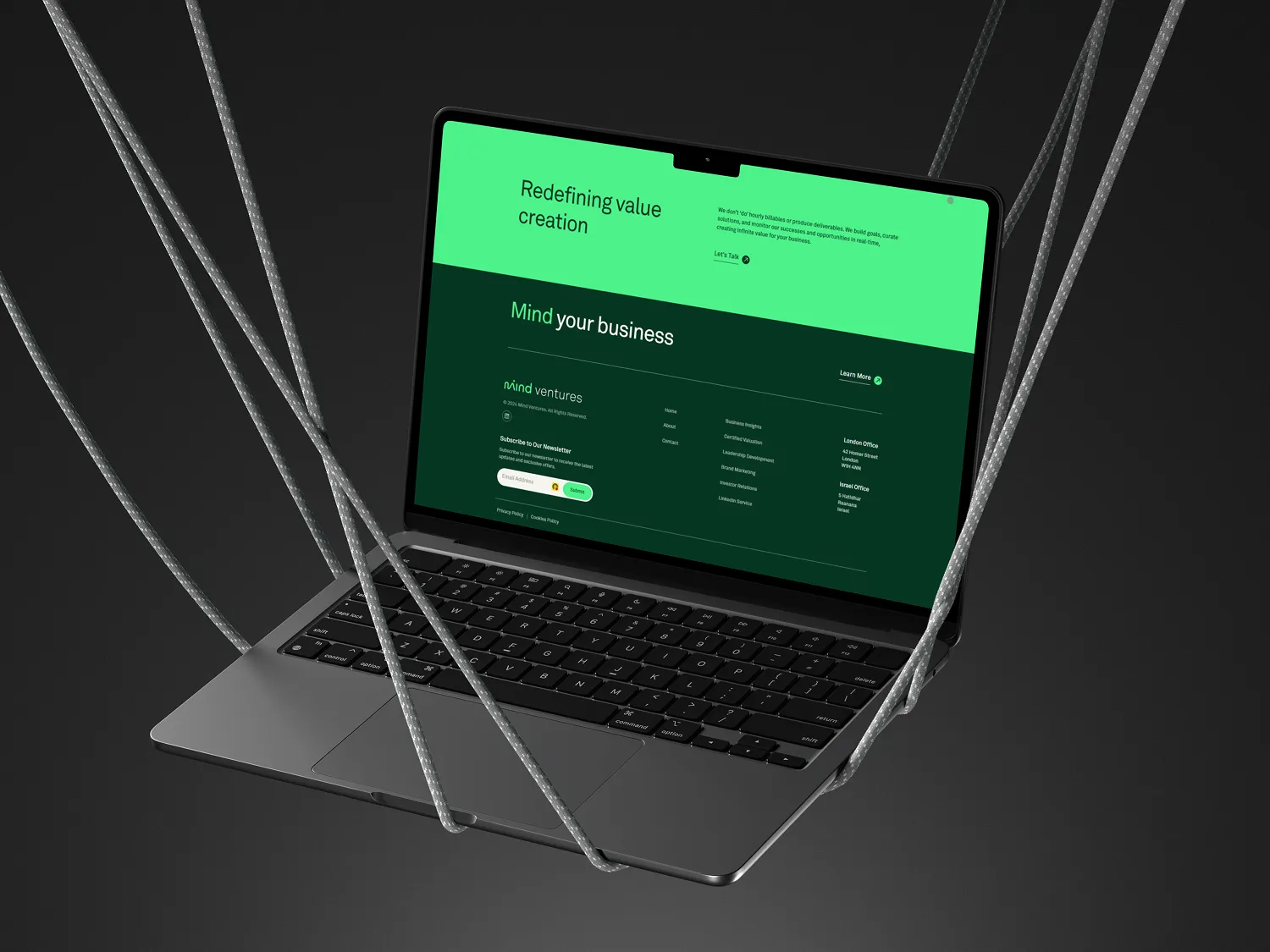
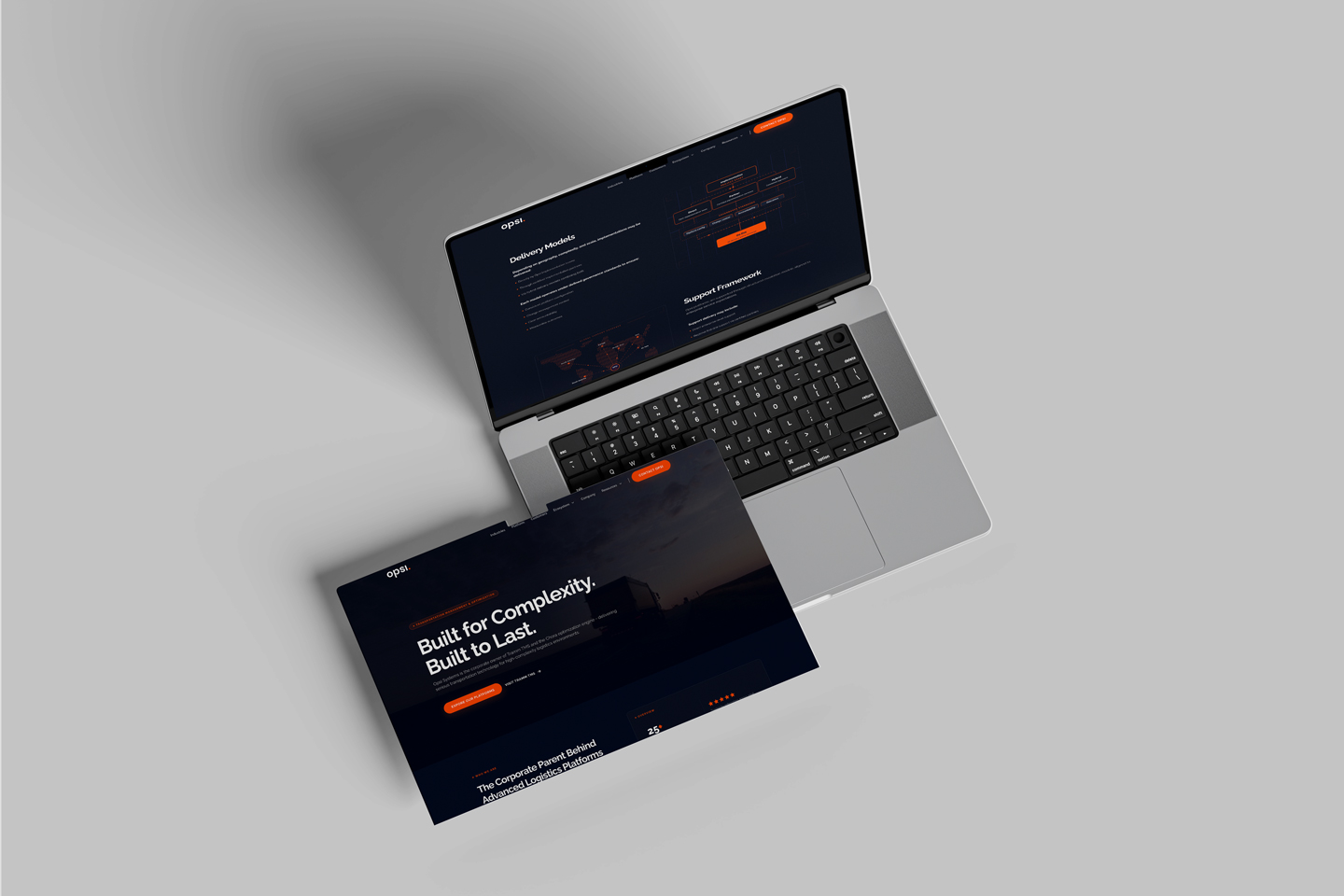
Webflow sites we've shipped
A selection of recent B2B brand and product sites built on Webflow.




Who we build for
We're a fit for ambitious B2B teams in three shapes.
Mid-market B2B SaaS
Series A through D companies whose marketing team needs to ship weekly without a developer on standby.
Professional services & consultancies
Boutique firms whose website is the proof of expertise — design fidelity matters, and the team needs to publish thought leadership without friction.
Venture-backed scale-ups
Teams between launch and Series C that need an AEO-ready site today and the option to migrate to a custom React stack tomorrow.
BrandingLab is an Accredited Webflow Partner — the tier reserved for agencies with verified expertise, certified team members and documented client outcomes. We work directly with Webflow's enterprise team on roadmap features and migrations.
Frequently asked questions
The questions we hear most from B2B teams evaluating Webflow.
Let's build something remarkable
Whether you're rebuilding an existing site or starting from a blank canvas, we'll ship a Webflow build your team can run — and your buyers will remember.